Saturday, April 18, 2015

Americanah, May Book


NPR's Jennifer Reese calls "Americanah" a "rich and gloriously detailed tapestry ... hung on the sturdy scaffolding of a sweet love story." Those glorious details are Adichie's insightful observations of the human social condition. They abound throughout the story.

In "Americanah",  Chimamanda Ngozi Adichie tackles the question, "What is the difference between an African-American and an American-African?" She was born in Nigeria where she wasn't aware that she was black; not until she emigrated to the United States.


An example of the fine differentiations she succeeds in communicating to American readers: 
In college, the African-American joins the Black Student Union, while the American-African signs up with the African Students Association.  When thinking of race and class, Americans instinctively speak of “blacks and poor whites,” not “poor blacks and poor whites.”
 
“Americanah” tells the story of a smart, strong-willed Nigerian woman named Ifemelu who, after she leaves Africa for America, endures several harrowing years of near destitution before graduating from college, starting a blog entitled “Raceteenth or Various Observations About American Blacks (Those Formerly Known as Negroes) by a Non-­American Black” and winning a fellowship at Princet­on. Her high school boyfriend, Obinze, remains in Nigeria after an unsuccessful attempt to emigrate. He becomes a successful businessman. A complicated, long distance relationshiop ensues.

Leah Gessner


Saturday, March 21, 2015

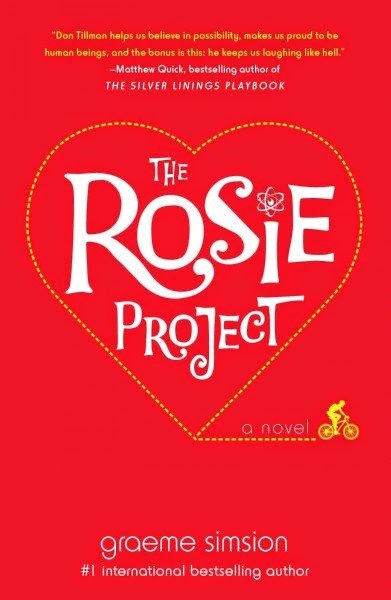
The Rosie Project, April Book


Graeme Simsion, a New Zealand born, Australian author, has created Don Tillman, a brilliant yet socially challenged professor of genetics, who decides it’s time he found a wife. And so, in the orderly, evidence-based manner with which Don approaches all things, he designs the Wife Project to find his perfect partner: a sixteen-page, scientifically valid survey.

Rosie Jarman, strangely beguiling, fiery, and intelligent shows up. While Don quickly disqualifies her as a candidate for the Wife Project, as a DNA expert, he is particularly suited to help Rosie on her own quest: identifying her biological father.

Arrestingly endearing and entirely unconventional, this novel will resonate with anyone who has ever tenaciously gone after life or love in the face of great challenges. Although set in his geeky ways and distinctly disadvantaged when it comes to tact, Don's underlying sweetness and charm endears him to the reader. The Rosie Project is in part about the joy that can come from openness to change. The Rosie Project is a rare find: a book that restores our optimism in the power of human connection while offering lots of amusement, sharp dialogue, fast pacing, hijinks, slapstick and surprises.

(excerpts from LitLover and NPR Reviews)

Leah Gessner


Wednesday, February 25, 2015

Without You There Is No Us, March Book


Suki Kim says of her chilling memoir, "It was a world where they invented their own truth and I had always been obsessed with it. So in 2011, I managed to get a job teaching English to the 19-year-old sons of North Korea’s ruling class at a brand-new university staffed only by foreigners. I lived on a walled campus with the students and ate all my meals with them, and was constantly monitored by minders. I kept notes whenever I could, erasing everything from my computer and keeping it on USB sticks, which I carried on my body. What I wrote would become Without You, There Is No Us.

According to the December 11, 2014 NY Times review, "the book takes its title from a patriotic song extolling the Great General Comrade Kim Jong-il, whose death was announced on what happened to be the day of the author's final class in the Democratic People's Republic. The book reminds us that evil is not only banal; it is also completely arbitrary."

The reader will be amazed to read about the shocking technological backwardness of Kim's students, even though the institution they attend is the Pyongyang University of Science and Technology. The students do have ­access to an internal network, or intranet, but it’s not connected to the Internet, and they use their computers mostly as dictionaries.

Kim can’t help wondering whether she has literally endangered her students by giving them a sense of hope. “I hope they have forgotten everything I inspired in them,” she writes.

Suki Kim was born and raised in Seoul. She lives in NY and has been traveling to North Korea as a journalist since 2002.

For more enticing tidbits about what lies ahead in Without You, There Is No Us, click on the following links to go to the NY Times review or to Suki Kim's website. I recommend her photo album from North Korea.

http://www.sukikim.com/album

 Leah Gessner


Saturday, January 24, 2015

Elephant Company, February Book


Talk About Books meets at the Guilford Free Library every 3rd Wednesday of the month. On Wednesday, February 18 at 6:30, we will be discussing Elephant Company by Vicki Constantine Croke. This is "the inspiring story of an unlikely hero and the animals who helped him save lives in World War II. Copies are available at the library.

Our “unlikely hero” is Lt. Col. James Howard Williams, a dashing, athletic man with a deep attachment to animals of all kinds, and an uncanny ability to communicate with them. Shortly after Williams returned from World War I, a chance meeting and the mere mention of elephants were all it took for the animal lover to apply for a job as an elephant wallah with the Bombay Burmah Trading Corporation.

On arriving at camp, he was shown a row of elephants and told, “Those four on the right are yours, and God help you if you can’t look after them.” Williams had no idea what that entailed, but his uncanny rapport with the elephants transformed him from a carefree young man into the charismatic war hero known as Elephant Bill. Impressed with their intelligence, courage, kindness, and humor, he believed that just living with the elephants made him a better man. He worked to cure their ills and he fought for their humane care.

This work of nonfiction is the result of Croke's detailed research.  Though rich in information, Sara Gruen (author of Water for Elephants) writes in the NY Times Sunday Book Review, "it is about far more than just the war, or even elephants. This is the story of friendship, loyalty and breathtaking bravery that transcends species." Part biography, part war epic, and part wildlife adventure, Elephant Company is an inspirational narrative that illuminates a little-known chapter in the annals of wartime heroism.

What more can I say? Come get a copy and join us on February 18th. Meantime, go to vickicroke.com for a fascinating browse.

Leah Gessner


Saturday, January 3, 2015

Orphan Train, January Book


Christina Baker Kline delivers her most ambitious and powerful novel to date; a captivating story of two very different women who build an unexpected friendship: a 91-year-old woman with a hidden past as an orphan-train rider and the teenage girl whose own troubled adolescence leads her to seek answers to questions no one has ever thought to ask.

Nearly eighteen, Molly Ayer knows she has one last chance. Just months from "aging out" of the child welfare system, and close to being kicked out of her foster home, a community service position helping an elderly woman clean out her home is the only thing keeping her out of juvie and worse.

Vivian Daly has lived a quiet life on the coast of Maine. But in her attic, hidden in trunks, are vestiges of a turbulent past. As she helps Vivian sort through her possessions and memories, Molly discovers that she and Vivian aren't as different as they seem to be. A young Irish immigrant orphaned in New York City, Vivian was put on a train to the Midwest with hundreds of other children whose destinies would be determined by luck and chance.

Rich in detail and epic in scope, Orphan Train is a powerful novel of upheaval and resilience, of second chances, of unexpected friendship, and of the secrets we carry that keep us from finding out who we are.


 Christina Baker Kline writes in her website that "Orphan Train is a specifically American story of mobility and rootlessness, highlighting a little-known but historically significant moment in our country’s past. Between 1854 and 1929, so-called “orphan trains” transported more than 200,000 orphaned, abandoned, and homeless children – many of them first-generation Irish Catholic immigrants – from the coastal cities of the eastern United States to the Midwest for “adoption” (often, in fact, indentured servitude). Charles Loring Brace, who founded the program, believed that hard work, education, and firm but compassionate childrearing – not to mention Midwestern Christian family values – were the only way to save these children from a life of depravity and poverty."

Go to Christina Baker Kline's website to learn more about this fascinating piece of history and why the author was inspired to write about it.

www.christinabakerkline.com

Saturday, November 29, 2014

The Optimist's Daughter, December book

At the last Talk About Books in November, we each presented a book we had read recently. One of the the books was a new memoir about Harper Lee, The Mockingbird Next Door by Marja Mills. We were all familiar with Lee's well-loved Pulitzer Prize winner, To Kill a Mockingbird, so we decided to follow Harper Lee's advice and try one of her favorite authors, Eudora Welty. Both Welty and Lee grew up in the South ( Mississippi and Alabama) and both remained true to their roots all their lives.

We chose The Optimist's Daughter. It won a Pulitzer Prize for Fiction and is considered by many to be her best book. It is the story of Laurel McKelva Hand, a young woman who has left the South and returns, years later, to New Orleans, to take care of her father, Judge McKelva, who is dying. After his death, she and her immature young stepmother go back still farther, to the small Mississippi town where she grew up. Alone in the the old house, Laurel finally comes to an understanding of the past, herself, and her parents.

In his New York Times Book Review, May 21, 1972, Howard Moss praised The Optimist's Daughter as "a miracle of compression, the kind of book, small in scope but profound in its implications, that rewards a lifetime of work. Its style is at the service of a story that follows its nose with the instincts of a good hunting dog never losing the scent of its quarry. And its story has all those qualities peculiar to the finest short novels: a theme that vibrates with overtones, suspense and classical inevitability."

Tuesday, September 23, 2014

The Innocents Abroad, October book

Who could read the programme for the excursion without longing to make one of the party? So Mark Twain acclaims his voyage from New York City to Europe and the Holy Land in June 1867. His adventures produced The Innocents Abroad, a book so funny and provocative it made him an
international star for the rest of his life. He was making his first responses to the Old World - to Paris, Milan, Florence, Venice, Pompeii, Constantinople, Sebastopol, Balaklava, Damascus, Jerusalem, Nazareth, and Bethlehem. For the first time he was seeing the great paintings and sculptures of the Old Masters . He responded with wonder and amazement, but also with exasperation, irritation, disbelief. Above all he displayed the great energy of his humour, more explosive for us now than for his beguiled contemporaries.

 map of Twain's travel