Fates and Furies by Lauren Groff tells a the story of a marriage from two
sides. Every relationship has two perspectives. And sometimes, it turns
out, the key to a great marriage is not its truths but its secrets. At
the core of this rich, expansive, layered novel, Lauren Groff presents
the story of one such marriage over the course of twenty-four years.
According to Jason Sheehan in his September 15, 2015 book review for npr, "The book is a master class in best lines; a shining, rare example of that most unforgiving and brutal writer's advice: All
you have to do is write the best sentence you've ever written. Then
10,000 more of the best. Then find a way to string them together into
the story of something.
At
age twenty-two, Lotto and Mathilde are tall, glamorous, madly in love,
and destined for greatness. A decade later, their marriage is still the
envy of their friends, but with an electric thrill we understand that
things are even more complicated and remarkable than they have seemed. The voice that tells Lotto's half of the tale is dreamy. Mathilde's is
rougher, crueler. A Greek chorus chimes in now and then in snarky,
bracketed asides, which work beautifully within the architectural
construction of Groff's voice.
By the end of Fates And Furies, we have seen both sides, maybe even all sides of Lotto and Mathilde. We've seen the man and the woman behind
the man, borne witness to terrible truths brought forth for spite's sake
and watched a dark turn to furious vengeance when Mathilde (suddenly,
but not at all uncharacteristically) goes full Lady MacBeth and scorches
the very earth. We know their secrets. We know their fears."
Saturday, April 30, 2016
Wednesday, March 2, 2016
The Sandcastle Girls, April Book
The year 2015 marked the 100th anniversary of the Armenian genocide,
and Chris Bohjalian’s novel, “The Sandcastle
Girls,’’ represents just the beginning of what will be a steady
stream of publications remembering this tragedy. Unlike his mystery
books, this one is a historical romance.
Her quest takes her back to 1915, when the rulers of the Ottoman Empire used World War I as an opportunity to exterminate the Armenian minority, whom they feared might ally itself with the Russians. Many Armenians were outright massacred; many more were exiled on forced death marches through the desert.
Through Elizabeth and Armen’s travels and travails, we are taken from the battleground of Gallipoli to the concentration camp of Dar-El-Zor, meeting missionaries, soldiers, and victims along the way. Bohjalian (three of his four Armenian grandparents died in the genocide and war) resists caricature and presents this appalling history largely through the eyes of its victims and those who valiantly try to help them.
Saturday, February 20, 2016
97 Orchard, March Book
In “97 Orchard:
An Edible History of Five Immigrant Families in One New York Tenement", Jane Ziegelman tells about Old World habits clashing and ultimately
melding with new American ones.
The
Glockners, the Moores, the Gumpertzes, the Rogarshevskys and the
Baldizzis, who all lived at 97 Orchard Street, on the Lower East Side
of Manhattan, between 1863 and 1935, were
busy families who all wanted many things: assimilation, esteem, easier lives
for their children. Most of all, it seems, they wanted full bellies and
tastes of home. They were fiercely loyal to the dishes they left behind.
In
part, “97 Orchard” is about real estate. Ziegelman traces the
history of tenement buildings in Manhattan, noting that they were the
“first American residences built expressly for multiple families — in
this case, working people.” By the start of the 20th century, she
writes, “97 Orchard Street stood on the most densely populated square
block of urban America, with 2,223 people, most of them Russian Jews,
packed into roughly two acres.”
These days 97 Orchard Street is the site of the Lower East Side Tenement Museum.
During most of the years Ziegelman writes about, the building’s
tiny apartments had no indoor plumbing and no refrigerators except
windowsills in winter; the kitchens had wood- or coal-burning stoves.
Tenement housewives were “human freight elevators, hauling groceries,
coal, firewood and children up and down endless flights of stairs.”
Ziegelman writes about the types of culinary workers, once popular
in and around these tenements, whose trades have vanished. These
included “the German krauthobblers, or ‘cabbage-shavers,’ itinerant
tradesmen who went door to door slicing cabbage for homemade
sauerkraut,” she notes. There were also “the Italian dandelion pickers,
women who scoured New York’s vacant lots for wild salad greens,” as well as urban goose farmers who raised poultry in basements and hallways.
Ziegelman also writes about Ellis Island and about what she calls
“the first all-important point of contact between the United States
government and its future citizens.” Hearts and minds needed to be won,
and stomachs too. The food at Ellis Island improved with time, she
writes, thanks to men like Frederick Wallis, immigration commissioner
from 1920 to 1921, who wisely observed: “You can make an immigrant an
anarchist overnight at Ellis Island, but with the right kind of
treatment you can also start him on the way to glorious citizenship. It
is first impressions that matter most.”
Saturday, February 6, 2016
Middlemarch, February Book
In 1873, the poet Emily Dickinson referred to the novel, Middlemarch, in a letter: "What do I think of Middlemarch? What do I think of glory – except that in a few instances 'this mortal [George Eliot] has already put on immortality'." Such high praise is appropriate for a novel which is considered one of the best 100 novels, perhaps the greatest of the great Victorian fictions.
Middlemarch has been referred to as a "cathedral of words". Readers can enjoy this book on many levesl. The writing is sublime, meticulously descriptive, witty, and beautiful. The characters are varied and interesting and the setting is a vivid representation of life in a Victorian English village in the Midlands.
George Eliot's masterpiece, Middlemarch, appeared after the
deaths of Thackeray (1863) and Dickens (1870). This is hardly an
accident. Subtitled "a study of provincial life", the novel has a
didactic realism that's a world away from Vanity Fair or Great Expectations.
Few of Eliot's characters achieve what they really want, and all have to learn to compromise. Some learn the lessons and achieve a temporary happiness. Others refuse or are incapable of learning, and spend their lives resenting their situation, and blaming others. And others still realize their mistakes but are trapped by a wrong decision and never escape.
Saturday, December 26, 2015
Empire Falls, January Book
In 2002, Richard Russo was awarded the Pulitzer Prize for distinguished fiction by an American author, preferably dealing with American life.
Pulitzer.org/works writes the following review of Empire Falls:
Richard Russo - from his first novel, Mohawk, to his most recent, Straight Man-has demonstrated a peerless affinity for the human tragicomedy, and with this stunning new novel he extends even further his claims on the small-town, blue-collar heart of the country.
Dexter County, Maine, and specifically the town of Empire Falls, has seen better days, and for decades, in fact, only a succession from bad to worse. One by one, its logging and textile enterprises have gone belly-up, and the once vast holdings of the Whiting clan (presided over by the last scion's widow) now mostly amount to decrepit real estate. The working classes, meanwhile, continue to eke out whatever meager promise isn't already boarded up.
Miles Roby gazes over this ruined kingdom from the Empire Grill, an opportunity of his youth that has become the albatross of his daily and future life. Called back from college and set to work by family obligations-his mother ailing, his father a loose cannon-Miles never left home again. Even so, his own obligations are manifold: a pending divorce; a troubled younger brother; and, not least, a peculiar partnership in the failing grill with none other than Mrs. Whiting. All of these, though, are offset by his daughter, Tick, whom he guides gently and proudly through the tribulations of adolescence.
A decent man encircled by history and dreams, by echoing churches and abandoned mills, by the comforts and feuds provided by lifelong friends and neighbors, Miles is also a patient, knowing guide to the rich, hardscrabble nature of Empire Falls: fathers and sons and daughters, living and dead, rich and poor alike. Shot through with the mysteries of generations and the shattering visitations of the nation at large, it is a social novel of panoramic ambition, yet at the same time achingly personal. In the end, Empire Falls reveals our worst and best instincts, both our most appalling nightmares and our simplest hopes, with all the vision, grace and humanity of truly epic storytelling.
Wednesday, October 28, 2015
A Fall of Marigolds, November Book
A Fall of Marigolds by Susan Meissner is a novel about love, loss and the bonds that connect us through generations.
Nurse Clara Wood is working on Ellis Island in New York Harbor in September 1911. She has suffered the loss of the man she loved in the horrific Triangle Shirtwaist Fire. While caring for a sick immigrant, she notices a name embroidered on his scarf and finds herself in a dilemma that forces her to re-look at her life.
In September 2011, Taryn Michaels, a widow, is living a good life, raising a daughter and working in Manhattan. Like Clara, she has suffered the loss of a loved one, her husband who died in the collapse of the World Trade Towers. A chance reconnection and a century old scarf has the potential of changing her life.
This book is described as beautifully crafted and captivating as it weaves together two devastating New York tragedies, the fire and 9/11. The story confronts the fact of life we all live with - disaster can quickly take away what we hold most dear, yet we can still go forward with hope and renewed love.
Wednesday, September 30, 2015
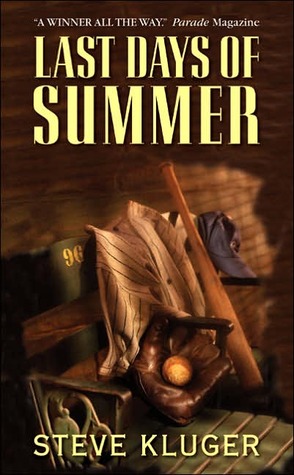
Last Days of Summer, October Book
Steve Kluger's Last Days of Summer is a hilarious and heart–warming story about a down and out kid who finds inspiration in his favorite baseball hero.
This is a coming of age novel in which Kluger uses letters, newspaper clippings, war bulletins, ticket stubs and even report cards to tell the story of Joey Margolis, a precocious twelve year old who is in need of a hero. Joey is growing up Jewish in a tough Brooklyn neighborhood in the 1940's.
Constant bullying from the kids in the neighborhood leads him to write to to Charlie Banks, an up and coming star with the New York Giants, asking for a home run so he can tell everyone that it was for him. This is not easy, but Joey uses every trick in the book to get what he wants. The friendship that comes out of their simple correspondence will change them both forever.
The joys and sorrows of growing up will always have an audience and this novel sheds light on all the complexity of those difficult times, with humour and joy.
This is a coming of age novel in which Kluger uses letters, newspaper clippings, war bulletins, ticket stubs and even report cards to tell the story of Joey Margolis, a precocious twelve year old who is in need of a hero. Joey is growing up Jewish in a tough Brooklyn neighborhood in the 1940's.
Constant bullying from the kids in the neighborhood leads him to write to to Charlie Banks, an up and coming star with the New York Giants, asking for a home run so he can tell everyone that it was for him. This is not easy, but Joey uses every trick in the book to get what he wants. The friendship that comes out of their simple correspondence will change them both forever.
The joys and sorrows of growing up will always have an audience and this novel sheds light on all the complexity of those difficult times, with humour and joy.
Subscribe to:
Posts (Atom)