Saturday, February 6, 2016

Middlemarch, February Book

In 1873, the poet Emily Dickinson referred to the novel, Middlemarch, in a letter: "What do I think of Middlemarch? What do I think of glory – except that in a few instances 'this mortal [George Eliot] has already put on immortality'." Such high praise is appropriate for a novel which is considered one of the best 100 novels, perhaps the greatest of the great Victorian fictions.
 
Middlemarch has been referred to as a "cathedral of words".  Readers can enjoy this book on many levesl. The writing is sublime, meticulously descriptive, witty, and beautiful. The characters are varied and interesting and the setting is a vivid representation of  life in a Victorian English village in the Midlands.

George Eliot's masterpiece, Middlemarch, appeared after the deaths of Thackeray (1863) and Dickens (1870). This is hardly an accident. Subtitled "a study of provincial life", the novel has a didactic realism that's a world away from Vanity Fair or Great Expectations.


Few of Eliot's characters achieve what they really want, and all have to learn to compromise. Some learn the lessons and achieve a temporary happiness. Others refuse or are incapable of learning, and spend their lives resenting their situation, and blaming others. And others still realize their mistakes but are trapped by a wrong decision and never escape. 


Saturday, December 26, 2015

Empire Falls, January Book


In 2002, Richard Russo was awarded the Pulitzer Prize for distinguished fiction by an American author, preferably dealing with American life.  

Pulitzer.org/works writes the following review of Empire Falls:

Richard Russo - from his first novel, Mohawk, to his most recent, Straight Man-has demonstrated a peerless affinity for the human tragicomedy, and with this stunning new novel he extends even further his claims on the small-town, blue-collar heart of the country.
Dexter County, Maine, and specifically the town of Empire Falls, has seen better days, and for decades, in fact, only a succession from bad to worse. One by one, its logging and textile enterprises have gone belly-up, and the once vast holdings of the Whiting clan (presided over by the last scion's widow) now mostly amount to decrepit real estate. The working classes, meanwhile, continue to eke out whatever meager promise isn't already boarded up.
Miles Roby gazes over this ruined kingdom from the Empire Grill, an opportunity of his youth that has become the albatross of his daily and future life. Called back from college and set to work by family obligations-his mother ailing, his father a loose cannon-Miles never left home again. Even so, his own obligations are manifold: a pending divorce; a troubled younger brother; and, not least, a peculiar partnership in the failing grill with none other than Mrs. Whiting. All of these, though, are offset by his daughter, Tick, whom he guides gently and proudly through the tribulations of adolescence.
A decent man encircled by history and dreams, by echoing churches and abandoned mills, by the comforts and feuds provided by lifelong friends and neighbors, Miles is also a patient, knowing guide to the rich, hardscrabble nature of Empire Falls: fathers and sons and daughters, living and dead, rich and poor alike. Shot through with the mysteries of generations and the shattering visitations of the nation at large, it is a social novel of panoramic ambition, yet at the same time achingly personal. In the end, Empire Falls reveals our worst and best instincts, both our most appalling nightmares and our simplest hopes, with all the vision, grace and humanity of truly epic storytelling.

Wednesday, October 28, 2015

A Fall of Marigolds, November Book

A Fall of Marigolds by Susan Meissner is a novel about love, loss and the bonds that connect us through generations.
Nurse Clara Wood is working on Ellis Island in New York Harbor in September 1911. She has suffered the loss of the man she loved in the horrific Triangle Shirtwaist Fire. While caring for a sick immigrant, she notices a name embroidered on his scarf and finds herself in a dilemma that forces her to re-look at her life.
In September 2011, Taryn Michaels, a widow, is living a good life, raising a daughter and working in Manhattan. Like Clara, she has suffered the loss of a loved one, her husband who died in the collapse of the World Trade Towers. A chance reconnection and a  century old scarf has the potential of changing her life.

This book is described as beautifully crafted and captivating as it weaves together two devastating New York tragedies, the fire and 9/11. The story confronts the fact of life we all live with -  disaster can quickly take away what we hold most dear, yet we can still go forward with hope and renewed love.


Wednesday, September 30, 2015

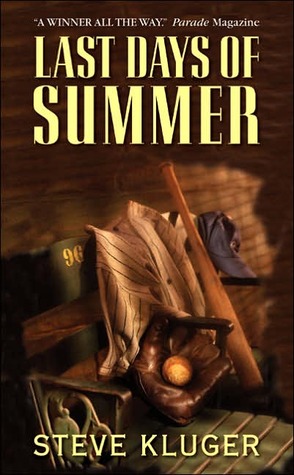
Last Days of Summer, October Book

Steve Kluger's Last Days of Summer is a hilarious and heart–warming story about a down and out kid who finds inspiration in his favorite baseball hero.

This is a coming of age novel in which Kluger uses letters, newspaper clippings, war bulletins, ticket stubs and even report cards to tell the story of Joey Margolis, a precocious twelve year old who is in need of a hero. Joey is growing up Jewish in a tough Brooklyn neighborhood in the 1940's.

Constant bullying from the kids in the neighborhood leads him to write to to Charlie Banks, an up and coming star with the New York Giants, asking for a home run so he can tell everyone that it was for him. This is not easy, but Joey uses every trick in the book to get what he wants. The friendship that comes out of their simple correspondence will change them both forever.

The joys and sorrows of growing up will always have an audience and this novel sheds light on all the complexity of those difficult times, with humour and joy.

1491: New Revelations of the Americas Before Columbus, September Book

1491: New Revelations of the Americas Before Columbus is a 2005 non-fiction book by American author and science writer Charles Mann about the pre-Columbian Americas. 
 
The book argues that a combination of recent findings in different fields of research suggests that human populations in the Western Hemisphere, the indigenous peoples of the Americas, were more numerous, had arrived earlier, were more sophisticated culturally, and controlled and shaped the natural landscape to a greater extent than scholars had previously thought.
 
 For example, Mann takes issue with the notion that European technologies in the 17th century were more advanced that those of the Indians. He uses guns as on e of many examples. The Indians thought of them as "noisemakers", more difficult to aim than arrows. Indeed,  John Smith of the Jamestown colony noted that "the awful truth..it could not shoot as far as an arrow could fly."


Tuesday, July 21, 2015

Why Does the World Exist?, August Book

Why Does the World Exist? is an existential detective story.

Jim Holt dares to ask the question. "Why?" “Why is there something rather than nothing?” You would think that so basic a question must have perplexed people since the beginning of philosophical musings. Actually, there is no evidence in early written literature. Early philosophers, such as Aristotle, wondered what the world was made of, but they didn't ask why it is here. 

Jim's search for answers leads him and his readers on a surprisingly lively journey, given the profound nature of the topic. He travels to Paris, London, Oxford, Pittsburgh and Austin, Texas, to meet the philosophers and cosmologists David Deutsch, Adolf Grünbaum, John Leslie, Derek Parfit, Roger Penrose, Richard Swinburne and Steven Weinberg. He also has a discussion with the philosophically inclined novelist John Updike. As he moves from one to the other, Holt learns of ever more extraordinary solutions, some almost mystical, yet rooted in solid reasoning.

Holt has a technical background in addition to his experiences as a writer and philosopher. He studied mathematics at the University of Virginia, and was a faculty fellow in the philosophy department at Columbia. He has been a contributor to The New York Times, Slate and New Yorker magazines.

Reviewers describe Why Does the World Exist? as a readable, sometimes even comical, search for answers to that question we all ask ourselves at some time or other.

You can see and hear Jim Holt talk about the book live on TED Talks:  https://www.ted.com/speakers/jim_holt#

Leah Gessner

Saturday, June 27, 2015

All-Girl Filling Station's Last Reunion, July Book

Yes. Fannie Flagg, that talented southern writer who is known and loved for her entertaining, wisdom-filled novels. Many reviewers consider The All-Girl Filling Station's Last Reunion her best novel yet. They say it rivals her famous Fried Green Tomatoes at the Whistle Stop Cafe which was adapted for the screen as "Fried Green Tomatoes" by Fannie Flagg herself. Before becoming a writer, Flagg appeared regularly on popular TV shows (Candid Camera, Match Game) and on stage (The Best Little Whorehouse in Texas).

In The All-Girl Filling Station's Last Reunion, Sookie Poole finds herself delving into the past where she discovers unexpected, amazing information about her mother; a mother who has been more of a trial than a joy. The new knowledge about who her mother really was inspires Sookie as she goes forward in her own life. Along the way, the reader gets to learn about a little known aspect of American 20th century history, including WASP, Women's Airforce Service Pilots.

I recommend watching an interview with Fannie Flagg on You Tube. Fannie talks about how she got the idea for the book and her approach to writing.  Go to: www.youtube.com. Search for Fannie Flagg interview with Southern Living.


It's hard to pass up a good story, and Fannie Flagg is a great story-teller; just right for a summer read.