Wednesday, September 30, 2015

1491: New Revelations of the Americas Before Columbus, September Book

1491: New Revelations of the Americas Before Columbus is a 2005 non-fiction book by American author and science writer Charles Mann about the pre-Columbian Americas. 
 
The book argues that a combination of recent findings in different fields of research suggests that human populations in the Western Hemisphere, the indigenous peoples of the Americas, were more numerous, had arrived earlier, were more sophisticated culturally, and controlled and shaped the natural landscape to a greater extent than scholars had previously thought.
 
 For example, Mann takes issue with the notion that European technologies in the 17th century were more advanced that those of the Indians. He uses guns as on e of many examples. The Indians thought of them as "noisemakers", more difficult to aim than arrows. Indeed,  John Smith of the Jamestown colony noted that "the awful truth..it could not shoot as far as an arrow could fly."


Tuesday, July 21, 2015

Why Does the World Exist?, August Book

Why Does the World Exist? is an existential detective story.

Jim Holt dares to ask the question. "Why?" “Why is there something rather than nothing?” You would think that so basic a question must have perplexed people since the beginning of philosophical musings. Actually, there is no evidence in early written literature. Early philosophers, such as Aristotle, wondered what the world was made of, but they didn't ask why it is here. 

Jim's search for answers leads him and his readers on a surprisingly lively journey, given the profound nature of the topic. He travels to Paris, London, Oxford, Pittsburgh and Austin, Texas, to meet the philosophers and cosmologists David Deutsch, Adolf Grünbaum, John Leslie, Derek Parfit, Roger Penrose, Richard Swinburne and Steven Weinberg. He also has a discussion with the philosophically inclined novelist John Updike. As he moves from one to the other, Holt learns of ever more extraordinary solutions, some almost mystical, yet rooted in solid reasoning.

Holt has a technical background in addition to his experiences as a writer and philosopher. He studied mathematics at the University of Virginia, and was a faculty fellow in the philosophy department at Columbia. He has been a contributor to The New York Times, Slate and New Yorker magazines.

Reviewers describe Why Does the World Exist? as a readable, sometimes even comical, search for answers to that question we all ask ourselves at some time or other.

You can see and hear Jim Holt talk about the book live on TED Talks:  https://www.ted.com/speakers/jim_holt#

Leah Gessner

Saturday, June 27, 2015

All-Girl Filling Station's Last Reunion, July Book

Yes. Fannie Flagg, that talented southern writer who is known and loved for her entertaining, wisdom-filled novels. Many reviewers consider The All-Girl Filling Station's Last Reunion her best novel yet. They say it rivals her famous Fried Green Tomatoes at the Whistle Stop Cafe which was adapted for the screen as "Fried Green Tomatoes" by Fannie Flagg herself. Before becoming a writer, Flagg appeared regularly on popular TV shows (Candid Camera, Match Game) and on stage (The Best Little Whorehouse in Texas).

In The All-Girl Filling Station's Last Reunion, Sookie Poole finds herself delving into the past where she discovers unexpected, amazing information about her mother; a mother who has been more of a trial than a joy. The new knowledge about who her mother really was inspires Sookie as she goes forward in her own life. Along the way, the reader gets to learn about a little known aspect of American 20th century history, including WASP, Women's Airforce Service Pilots.

I recommend watching an interview with Fannie Flagg on You Tube. Fannie talks about how she got the idea for the book and her approach to writing.  Go to: www.youtube.com. Search for Fannie Flagg interview with Southern Living.


It's hard to pass up a good story, and Fannie Flagg is a great story-teller; just right for a summer read.


Tuesday, May 26, 2015

Life After Life, June Book


I, for one, am eager to read "Life After Life" by Kate Atkinson. Everything I have read about this book peaks my curiosity.

First of all, the structure of the book is intriguing.  It could be titled "Life After Life After Life After Life ........" The central character, Ursula Todd is born and dies repeatedly as the structure of the book circles back and forward in time to explore alternative possible lives for her. It begins with Ursula's birth in 1910 to an upper middle class British family; first as a stillborn, but later as a healthy baby. Eventually she lives through World War II, works in the London War Office and witnesses the Blitz.

I am told by enthusiastic reviewers that this novel will convince us to suspend the will to disbelieve so that we can continue to follow Ursula through her lives, which start again and again, sometimes along very different paths and other times only slightly changed, but always in unpredictable ways.

The story begs questions such as: Can we make things better through the experience of repetition? Does the human condition have to include war?

"Life After Life" was chosen as one of the top ten books of 2013 by the New York Times Book Review, shortlisted for the Baileys Women's Prize for Fiction and the Walter Scott Prize and designated as a notable book for adults by the American Library Association.

At Talk About Books on June 19th we will find out who the believers are.

Leah Gessner

Saturday, April 18, 2015

Americanah, May Book


NPR's Jennifer Reese calls "Americanah" a "rich and gloriously detailed tapestry ... hung on the sturdy scaffolding of a sweet love story." Those glorious details are Adichie's insightful observations of the human social condition. They abound throughout the story.

In "Americanah",  Chimamanda Ngozi Adichie tackles the question, "What is the difference between an African-American and an American-African?" She was born in Nigeria where she wasn't aware that she was black; not until she emigrated to the United States.


An example of the fine differentiations she succeeds in communicating to American readers: 
In college, the African-American joins the Black Student Union, while the American-African signs up with the African Students Association.  When thinking of race and class, Americans instinctively speak of “blacks and poor whites,” not “poor blacks and poor whites.”
 
“Americanah” tells the story of a smart, strong-willed Nigerian woman named Ifemelu who, after she leaves Africa for America, endures several harrowing years of near destitution before graduating from college, starting a blog entitled “Raceteenth or Various Observations About American Blacks (Those Formerly Known as Negroes) by a Non-­American Black” and winning a fellowship at Princet­on. Her high school boyfriend, Obinze, remains in Nigeria after an unsuccessful attempt to emigrate. He becomes a successful businessman. A complicated, long distance relationshiop ensues.

Leah Gessner


Saturday, March 21, 2015

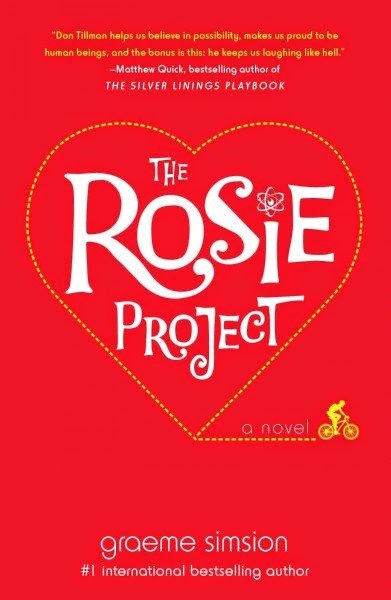
The Rosie Project, April Book


Graeme Simsion, a New Zealand born, Australian author, has created Don Tillman, a brilliant yet socially challenged professor of genetics, who decides it’s time he found a wife. And so, in the orderly, evidence-based manner with which Don approaches all things, he designs the Wife Project to find his perfect partner: a sixteen-page, scientifically valid survey.

Rosie Jarman, strangely beguiling, fiery, and intelligent shows up. While Don quickly disqualifies her as a candidate for the Wife Project, as a DNA expert, he is particularly suited to help Rosie on her own quest: identifying her biological father.

Arrestingly endearing and entirely unconventional, this novel will resonate with anyone who has ever tenaciously gone after life or love in the face of great challenges. Although set in his geeky ways and distinctly disadvantaged when it comes to tact, Don's underlying sweetness and charm endears him to the reader. The Rosie Project is in part about the joy that can come from openness to change. The Rosie Project is a rare find: a book that restores our optimism in the power of human connection while offering lots of amusement, sharp dialogue, fast pacing, hijinks, slapstick and surprises.

(excerpts from LitLover and NPR Reviews)

Leah Gessner


Wednesday, February 25, 2015

Without You There Is No Us, March Book


Suki Kim says of her chilling memoir, "It was a world where they invented their own truth and I had always been obsessed with it. So in 2011, I managed to get a job teaching English to the 19-year-old sons of North Korea’s ruling class at a brand-new university staffed only by foreigners. I lived on a walled campus with the students and ate all my meals with them, and was constantly monitored by minders. I kept notes whenever I could, erasing everything from my computer and keeping it on USB sticks, which I carried on my body. What I wrote would become Without You, There Is No Us.

According to the December 11, 2014 NY Times review, "the book takes its title from a patriotic song extolling the Great General Comrade Kim Jong-il, whose death was announced on what happened to be the day of the author's final class in the Democratic People's Republic. The book reminds us that evil is not only banal; it is also completely arbitrary."

The reader will be amazed to read about the shocking technological backwardness of Kim's students, even though the institution they attend is the Pyongyang University of Science and Technology. The students do have ­access to an internal network, or intranet, but it’s not connected to the Internet, and they use their computers mostly as dictionaries.

Kim can’t help wondering whether she has literally endangered her students by giving them a sense of hope. “I hope they have forgotten everything I inspired in them,” she writes.

Suki Kim was born and raised in Seoul. She lives in NY and has been traveling to North Korea as a journalist since 2002.

For more enticing tidbits about what lies ahead in Without You, There Is No Us, click on the following links to go to the NY Times review or to Suki Kim's website. I recommend her photo album from North Korea.

http://www.sukikim.com/album

 Leah Gessner